


There was a time in my life when going back to work simply wasn’t really an option. With my first born, we were navigating food intolerance related conditions that required constant attention. Reading labels, managing reactions, planning meals carefully and being present for every appointment and unexpected flare-ups. It wasn’t something I could delegate. It wasn’t something that fit neatly into a 9–5 schedule. And as much as I wanted to contribute financially, stepping back into traditional work just didn’t align with what our family needed at the time.
That’s when I realised my options were limited, unless I created new ones.
After doing extensive research and looking at many different options, I realised that blogging was one of the best online side hustles — flexible, realistic, and something I could build around our life instead of working against it.
It wasn’t glamorous. I didn’t know what SEO meant. I had no audience, no marketing plan, and definitely no grand vision. I just had a laptop, a few quiet hours, and the need to find an alternative income stream that worked for our circumstances.
Blogging became one of my first online side hustles as a mum, and this blog is proof of where that small, uncertain step can lead to. It didn’t happen overnight. There were learning curves and moments of doubt. But slowly, intentionally, it started to grow. And with it, so did my confidence.
If you’re here, maybe you’re in a similar season. Perhaps traditional work isn’t possible right now. Maybe childcare costs don’t make sense. Or maybe you simply want flexibility and control over your time.
The good news is, there are genuine online side hustles for mums that can fit around real family life — even complicated, unpredictable, beautiful family life.
In this post, I’ll share practical online side hustle ideas that can create income without sacrificing what matters most. Whether you’re starting from scratch or building on skills you already have, there are options available — and they’re more achievable than you might think.
Why Online Side Hustles Work Better for Parents
Before we dive into the specific side hustles, let’s talk about why online work just makes more sense when you’ve got kids.
Traditional jobs want you somewhere at certain times. Online side hustles? They mostly don’t care when you work, as long as the work gets done, also, there’s no commute. That’s an extra hour or two every day you’re not sitting in traffic or on a train.
Engaging in online side hustles not only provides parents with a much-needed supplemental income but also offers an opportunity to build marketable skills. Whether it’s through freelance writing, blogging or creating digital products, parents can develop skills that are valuable in the job market.
The online side hustles I’m sharing here aren’t temporary gigs that’ll disappear in six months. These are legitimate ways to build actual income streams that can grow as much or as little as you want them to.
Key Takeaways
- Supplemental income through remote work
- Provides an opportunity to develop marketable skills
- Enhanced financial stability and personal growth
- Ability to balance work and family responsibilities

Freelance Writing and Content Creation
With more companies relying on remote teams, freelance writing is one of the easiest side hustles parents can start from home. It offers schedule flexibility, low startup cost, and the opportunity to turn skills you already have – research, storytelling, and clear communication, into a steady income. Many writers begin part time during naptime or evenings and scale up as they find regular clients.
How to Start Your Freelance Writing Business
Starting a freelance writing business is straightforward if you follow a few practical steps. Begin by:
- Defining a niche that matches your knowledge and the market (e.g., parenting, health, small business, technology, hobbies, food)
- Creating a one-page portfolio or simple website that shows 2–4 samples and a short bio. Use social media channels such as Instagram, Facebook or Pinterest.
- Setting up profiles on freelance platforms and pitching directly to blogs or businesses.
Creating a Simple Portfolio Without Experience
If you don’t have paid samples yet, create them: write two short blog style articles, one product description, and one email/newsletter sample. Publish them on a free blog or a simple portfolio page. You can also guest post or write for friends’ businesses to get that first published work. Example one-page portfolio outline: a short bio (50–75 words), three labeled samples, services/pricing, and a clear contact method.
Identifying Your Writing Niche
Choose a niche by combining: your interests, past work or education, and market demand. For instance a parent with teaching experience could position themselves for education content or tutoring related articles. Narrow focus helps you attract higher paying clients and stand out from generalist writers. Make sure to spell check and ensure your articles have no grammar mistakes.
Content Types That Generate Consistent Income
- Blog posts — informative articles for company blogs (typical beginner rates: $20 – $100 per post; experienced niche writers often charge more).
- Copywriting — sales pages, email campaigns, and ads ($50–$500+ per project depending on scope).
- Technical or long-form guides — user manuals, whitepapers, and in-depth how-tos ($100–$1,000+ per project).
Blogging: Turn Your Parenting Experience Into Income
I started my blog on a random afternoon while my toddler was napping. I had no idea what I was doing. I just knew I had a lot of thoughts about parenting, food intolerance/gut health, dealing with picky eaters, meal planning which is all the stuff I was living through anyway. I initially wanted it to be a journal to help parents.
Four years later, that blog brings in more money than my old corporate job ever did.
Blogging gets a bad rap because people think it’s dead or oversaturated. It’s not, even with Youtube or short form video content. What’s dead is boring, generic content that just regurgitates what everyone else is saying. What works is real, specific, helpful content from someone who is actually lived through the thing they’re writing about.
How Parent Bloggers Actually Make Money
There are a bunch of different ways to monetize a blog:
Display ads – You put ads on your site through networks like Mediavine, Adsense or AdThrive, and you get paid based on how many people view your pages. Once you hit 50,000 monthly sessions, you can apply for Mediavine (the standard most bloggers aim for). Before that, you can use Google AdSense, though it pays much less.
Affiliate marketing – We will cover this in more detail, but blogs are perfect for affiliate content because you can write detailed reviews and tutorials.
Sponsored posts – Brands pay you to write about their products. Rates vary wildly—anywhere from $100 to $5,000+ per post depending on your traffic and niche.
Digital products – Sell your own ebooks, printables, courses, templates, whatever makes sense for your audience.
Coaching or services – Some bloggers use their blog as a platform to sell one-on-one coaching or consulting services.
Income Potential
Blogging may not help you earn money immediately, it takes time & effort, and that’s normal. You’re building an audience and figuring out what works. After a year of consistent work, $500-1,000 a month is realistic. After 2-3 years, if you’re strategic about it, $3,000-8,000 a month is achievable if you have the right strategies in place. Some parent bloggers make way more, but they’re usually treating it like a full-time business at that point.
SEO for Parent Bloggers (The Stuff That Actually Matters)
You need people to find your blog, and most of your traffic is going to come from Google. Here’s what actually moves the needle:
Write about things people are actively searching for. Use tools like Ubersuggest or AnswerThePublic to find questions parents are asking. “How to get toddler to sleep through the night” gets searched thousands of times a month. “My thoughts on motherhood” doesn’t.
Use keywords naturally throughout your post. In your title, in your headings, in the first paragraph, sprinkled throughout the content. But write for humans first, search engines second.
Make your content helpful. Google rewards content that actually answers the question thoroughly. A 500-word fluff piece won’t rank. A 2,000-word comprehensive guide might.
Get backlinks when you can. If another website links to your blog post, Google sees that as a vote of confidence. Guest posting on other blogs, getting mentioned in roundup posts, or creating content so good people naturally want to link to it—all of this helps.
The Reality Check
Blogging is a long game. If you need money next month, this isn’t your answer. But if you’re willing to put in consistent work for 6 months before seeing real returns, it can become one of the most flexible, scalable online side hustles for parents.
I work maybe around 8-10 hours a week on my blog now, and it is one of my top 3 income streams, it helps me keep my brand alive. But I also spent the first few months working way more hours for zero dollars. If you’re okay with that trade-off, blogging is worth it.
Affiliate Marketing: Get Paid for Recommending Stuff You Already Use
Here’s what affiliate marketing actually is, minus the hype: you recommend products or services you genuinely use and like, and when someone buys through your unique link, you get a commission. That’s it.
I started with this one almost by accident. I was already telling other moms about this baby carrier that saved my back, this meal planning app that saved my sanity, this specific brand of sippy cups that didn’t leak everywhere. One day someone said “you should put affiliate links on your blog for all this stuff.” So I did. And then I started making money while I slept.
How Affiliate Marketing Actually Works
You sign up for affiliate programs (most companies have them—Amazon, Target, individual brands, pretty much everyone). They give you a special tracking link. You share that link somewhere—your blog, social media, email, wherever. When someone clicks your link and buys something, you earn a percentage of that sale.
The percentage varies wildly. Amazon pays like 1-4% depending on the category (not great, but they sell everything). Individual brands sometimes pay 10-30%. Software companies often pay 20-50% because their profit margins are huge. Some programs even pay recurring commissions—meaning if someone subscribes to something, you get paid every single month they stay subscribed.

What You Actually Need to Get Started
You don’t need a massive following or some fancy website. You do need:
Somewhere to share your links. Could be a blog, Instagram account, YouTube channel, email list, TikTok, Facebook group—anywhere you’re already talking to people and there is a community
Products you actually use and believe in. Please don’t recommend random junk just because it pays well. People can smell fake recommendations from a mile away, and you’ll burn through any trust you’ve built.
Disclosure that you’re using affiliate links. It’s legally required, and also just honest. A simple “this post contains affiliate links, which means I may earn a commission if you purchase through my link” is fine.
Income Potential
This one’s all over the place. Some parents make $100 a month. Some make $10,000. I know one mom who makes six figures a year just from affiliate income, but she’s been at it for years and has a huge audience.
Realistically, if you’re just starting out? Maybe $50-200 your first few months. After six months to a year of consistent effort, $500-1,500 a month is achievable. The beautiful part is it’s mostly passive once you’ve created the content—those links keep earning even when you’re not actively working.
For parents specifically, programs in these niches tend to work well: baby products and parenting gear, meal planning and food delivery services, educational apps and subscriptions, home organization products, and family travel and activities.
The Real Talk
Affiliate marketing isn’t a “make money tomorrow” thing. It takes time to build an audience and figure out what resonates. But once you’ve got content out there with affiliate links, it can keep earning for months or even years.
The biggest mistake I see parents make is trying to promote everything. Pick a few things you genuinely love and would recommend anyway. Your authentic enthusiasm is what makes people actually click and buy.
Side Hustles With AI: The New Frontier
Okay, this section didn’t exist even two years ago. But AI tools have completely changed what’s possible for parents working online, and honestly? If you’re not at least aware of these opportunities, you’re leaving money on the table.
I was sceptical at first. “AI is going to take everyone’s jobs” seemed like the panic du jour. But what’s actually happening is AI is creating entirely new side hustles—and parents who learn to use these tools have a massive advantage.
AI Content Creation Services
Businesses need content constantly—blog posts, social media captions, email newsletters, product descriptions. Many are now willing to pay people who know how to use AI tools effectively to create this content faster and better.
You’re not just hitting “generate” and copying whatever ChatGPT spits out. You’re using AI as a research assistant, an outline creator, a first draft generator—then you’re editing, adding human insight, fact-checking, and making it actually good.
What this looks like: You might charge $200-500 to write a blog post that would normally take you 4 hours, but using AI for research and first drafts, you finish it in 90 minutes. Same quality (or better), but you’re earning way more per hour.
How to start: Learn to use tools like ChatGPT, Claude, or Jasper effectively. Practice on your own blog or social media first. Then start offering content creation services on Upwork, Fiverr, or directly to small businesses in your area.
AI-Assisted Graphic Design
Even if you have zero design skills, tools like Canva (which now has AI features built in), Midjourney, and DALL-E let you create professional-looking graphics, social media posts, logos, and marketing materials.
Small businesses, coaches, course creators—they all need this stuff constantly and don’t want to pay $500 to a professional designer for a simple Instagram post.
Income potential: $25-100 per graphic, $300-1,000 for a complete social media content package for a month.
What you need: Canva Pro subscription ($13/month), practice creating stuff that doesn’t look like generic AI art, and the ability to understand what a client actually wants (this is the part AI can’t do).
AI Prompt Engineering
This sounds fancy, but it’s basically knowing how to ask AI tools the right questions to get useful answers. Businesses are hiring people to create effective prompts for their specific needs—customer service responses, marketing copy, data analysis, whatever.
Real example: A friend of mine charges $500 to create a “prompt library” for small business owners – basically 50-100 pre-written prompts they can use in ChatGPT for their specific business. Takes her maybe 3 hours to create once she understands their business.
AI-Powered Virtual Assistant Work
Virtual assistant work has been around forever, but AI tools make it way more efficient. You can manage someone’s calendar, draft emails, create presentations, do research, handle social media—all faster and better using AI assistance.
The key: You’re not replacing yourself with AI. You’re using AI to handle the tedious parts so you can focus on the strategy and human judgment that clients actually pay for.
Getting Started With AI Side Hustles
Learn the tools. Spend time actually playing with ChatGPT, Claude, Midjourney, Canva AI, whatever tools are relevant to what you want to do. Free versions exist for most of these.
Practice on yourself first. Create content for your own blog, social media, or business before you offer it to clients.
Position yourself as an AI-savvy service provider, not an AI replacement. Businesses want humans who know how to leverage AI, not just AI output.
Stay updated. This field changes literally every month. Follow a few AI newsletters or YouTube channels to keep up.
Income Potential
This varies wildly because it’s all so new. But realistically:
- AI-assisted content creation: $500-3,000/month part-time
- AI graphic design services: $300-2,000/month
- AI prompt creation: $500-2,000/month
- AI-enhanced VA work: $1,000-5,000/month
The people making the most are the ones who got in early and actually understand both the AI tools AND the business problems they’re solving.
Virtual Assistant: Turning Administrative Skills Into Income
If you want something that pays consistently, doesn’t require months of audience-building, and lets you actually start earning this month—virtual assistant work is probably your best bet. As remote work grows, virtual assistant (VA) services have become a practical side hustle parents can start from home. VAs help business owners and busy professionals with routine tasks so those clients can focus on core work: and many parents find VA work fits into short, focused blocks of time like naptime or evenings.
What Virtual Assistants Actually Do
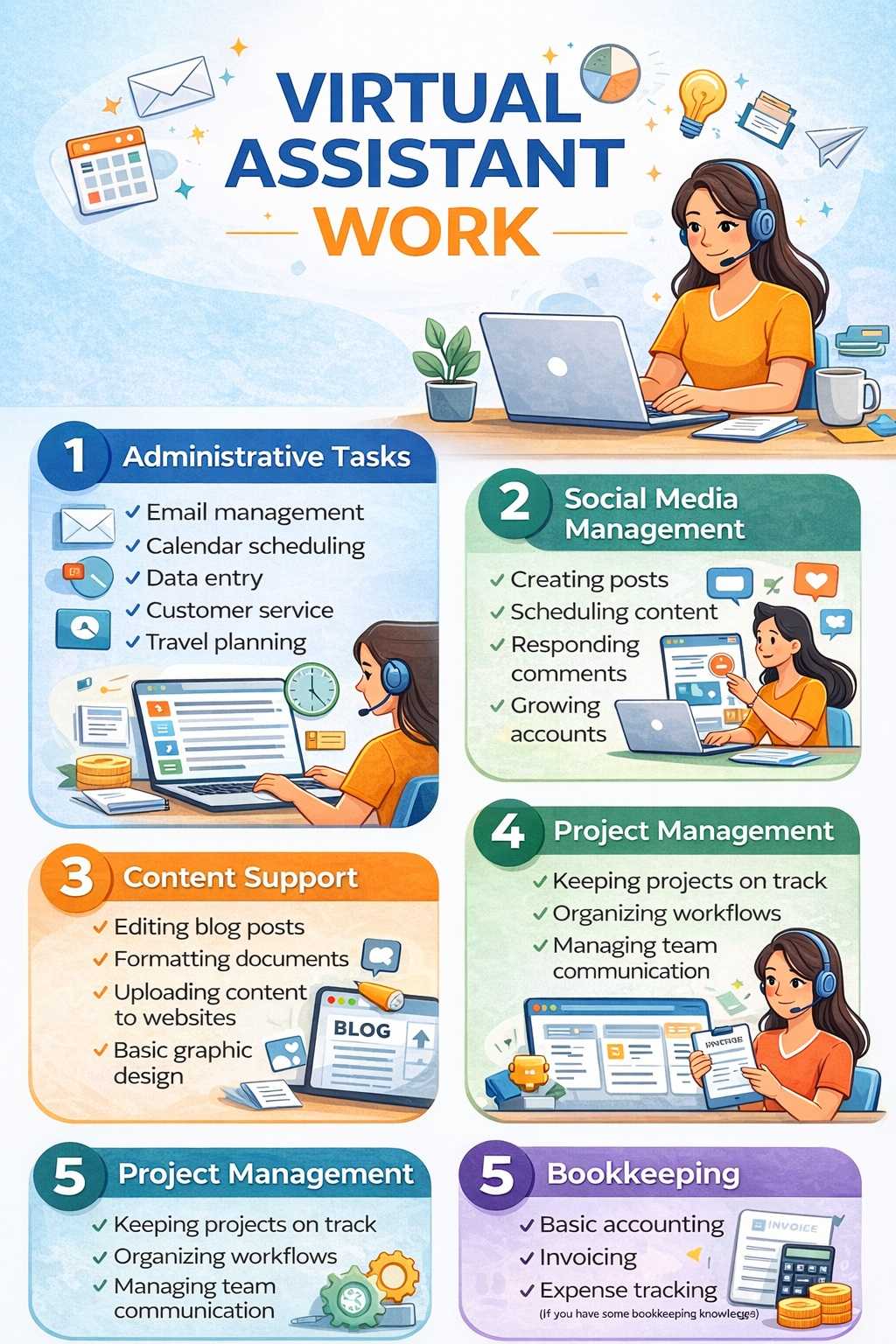
VA work is basically handling the administrative, technical, or creative tasks that busy people don’t have time for. Could be anything:
Administrative tasks: Email management, calendar scheduling, data entry, customer service, travel planning
Social media management: Creating posts, scheduling content, responding to comments, growing accounts
Content support: Editing blog posts, formatting documents, uploading content to websites, basic graphic design
Project management: Keeping projects on track, organizing workflows, managing team communication
Email marketing: Managing email lists, writing newsletters, setting up automation sequences
Bookkeeping: Basic accounting, invoicing, expense tracking (if you have some bookkeeping knowledge)
The beauty of VA work is you can specialize in whatever you’re already good at. If you are:
- Organized and good with people –> general admin work.
- Creative –> social media management.
- Detail oriented –> bookkeeping or project management.
Who Hires Virtual Assistants
Pretty much anyone who’s busy and has money to spend on help:
Small business owners, coaches and consultants, course creators and online entrepreneurs, busy executives, real estate agents, authors and content creators, e-commerce store owners.
How Much Virtual Assistants Make
VA rates are all over the map depending on your skills and experience.
- General admin work: $15-30/hour
- Social media management: $20-50/hour
- Specialized skills (email marketing, bookkeeping, project management): $30-75/hour
- Experienced VAs with proven results: $50-100+/hour
Most VAs working part-time (15-20 hours a week) make $1,200-3,000/month. Full-time VAs can easily hit $4,000-8,000/month or more.
Skills That Help (But Aren’t Required)
You don’t need fancy certifications to be a VA. Most of it is stuff you probably already know how to do. But these skills command higher rates:
- Email marketing platforms (Mailchimp, ConvertKit, ActiveCampaign)
- Project management tools (Asana, Trello, ClickUp)
- Social media scheduling (Later, Hootsuite, Buffer)
- Basic graphic design (Canva at minimum)
- WordPress or other website platforms
- Customer service experience
- Bookkeeping software (QuickBooks, MYOB, Xero)
The Parent-Friendly Part
VA work is incredibly flexible for parents because:
Most clients don’t care when you work, just that tasks get done. You can work during nap time, after bedtime, early mornings, whenever. Many VA tasks are asynchronous—you don’t need to be “on” at specific times. You can start with 5-10 hours a week and scale up as you’re ready. If you need to take a week off because your kid is sick, most clients are understanding as long as you communicate.
Essential Tools and Software You Need to Get Started
To be successful as a virtual assistant, you’ll need to familiarize yourself with various tools and software. These include project management tools like Trello and Asana, communication platforms like Zoom and Slack, and time tracking software like Harvest.
| Tool/Software | Purpose |
| Trello | Project management and organization |
| Zoom | Video conferencing and communication |
| Harvest | Time tracking and invoicing |
How to Set Your Rates as a Beginner VA
Setting your rates as a virtual assistant can be challenging, especially when you’re just starting out. Research the market to understand the going rate for virtual assistants and consider your skills and experience.
Tips for setting your rates:
- Research competitors and market rates
- Consider your skills, experience, and qualifications
- Start with a competitive rate and adjust as needed
How to Find VA Clients
Start with your network. Tell everyone you know you’re offering VA services. Someone knows someone who needs help.
VA-specific job boards: Belay, Time Etc, Fancy Hands (though these pay lower rates), and Upwork all have VA listings.
Facebook groups. There are tons of “Virtual Assistant Jobs” groups where people post opportunities.
Cold outreach. Find small business owners in your area or in industries you understand, and send them a brief email offering your services. This actually works better than you’d think.
Create a simple website or landing page. Doesn’t need to be fancy. Just clearly state what you do, who you help, and how to contact you.
Several platforms connect virtual assistants with clients. Some of the top platforms include Upwork, Fiverr, and Freelancer.
Popular platforms for virtual assistants:
- Upwork
- Fiverr
- Freelancer
My advice: Offer to work for someone at a reduced rate or even free for the first week or two, just to get a testimonial and some experience you can point to. I know, I know—working for free sucks. But it’s temporary, and it gets your foot in the door.
Once you have one good client and one solid testimonial, getting the second client is way easier. By your third or fourth client, you’ll probably have people reaching out to you.
Online Tutoring: Teaching KidsWhat You Already Know
Online tutoring and teaching are highly flexible side hustles that let parents leverage existing knowledge to earn extra income from home. Demand for remote learning grew during the pandemic and remains strong – especially for subject tutoring, language lessons, and skills like coding, making these roles a reliable way to supplement household income while building marketable teaching experience.
High-Demand Subject Areas and Grade Levels
Some areas consistently show strong demand:
- Math and science for primary, middle and high school students
- English language learning (ESL) for non-native speakers
- Test prep for SAT, ACT, and other standardized exams
- Special needs support (autism, ADHD) and personalized learning
- Coding and programming for kids and adults
Sample hourly pay ranges (illustrative): K–12 tutoring $15–$40/hr, test-prep $30–$80/hr, adult skills/classes $20–$60/hr — check platform rates for current figures in your region.
Reputable Platforms That Connect Tutors with Students
Use established marketplaces to find students quickly, or sell your own courses for passive income. Common options include:
- VIPKid — ESL-focused platform (primarily for teaching English to students abroad).
- Chegg Tutors — on-demand help across many school subjects.
- Teachers Pay Teachers — sell lesson plans, worksheets, and resources to other educators.
- Varsity Tutors — personalized tutoring in a wide range of subjects.
When evaluating platforms, compare pay rates, scheduling flexibility, payment frequency, and any background check requirements.
How to Get Your First Students — 3 Steps
- Create a clear offering: subject, grade level, price, and schedule.
- List on one platform and promote locally (parent groups, school newsletters, social media).
- Offer a discounted trial session to gather testimonials and refine your lesson plan.
Quick onboarding & safety note: many platforms require ID verification and background checks for tutors — be prepared to submit documentation and follow platform rules to build trust with families.
Structuring Your Teaching Schedule Around Family Time
Flexibility is a core advantage: schedule short sessions during nap times or afternoons, block evenings for higher rate sessions, and reserve weekends for prep or live classes. Use a calendar app to sync bookings, set clear availability, and allow for buffer time between sessions.
Social Media Management for Small Businesses: Monetizing Your Social Media Experience
Social media management has become a critical service for small businesses aiming to enhance their online visibility and customer engagement. As a parent with a knack for social media, you can turn this skill into a profitable freelance business.
How to Get Started
To start monetizing your social media skills, focus on building a strong personal brand. Showcase your expertise by creating engaging content around your niche. This could be through a blog, YouTube channel, or by demonstrating your knowledge on platforms like LinkedIn.
Key steps to monetize your experience include:
- Identifying your niche or area of expertise.
- Creating valuable content that resonates with your audience.
- Engaging with your followers to build a loyal community.
- Showcasing your skills to potential clients.
Services You Can Offer to Local and Online Businesses
As a social media manager, you can offer a variety of services to businesses. These include:
- Content creation and curation.
- Social media strategy development.
- Account setup and optimization.
- Engagement and community management.
- Analytics and reporting.
By offering these services, you can help businesses improve their online presence and reach their target audience more effectively.
Steps to Build Your First Client Base
Building your first client base requires strategic planning. Start by:
- Leveraging your existing network.
- Utilizing freelance platforms like Upwork or Fiverr.
- Creating a professional website to showcase your services.
- Engaging in local business communities or online forums.
Consistency and quality service are key to retaining clients and attracting new ones.
Time-Saving Tools for Managing Multiple Accounts
Managing multiple social media accounts can be streamlined with the right tools. Some essential tools include:
| Tool | Function |
| Hootsuite | Scheduling and managing posts across different platforms. |
| Buffer | Analyzing performance and scheduling content. |
| Sprout Social | Comprehensive social media management, including engagement and analytics. |
By leveraging these tools, you can save time and increase your productivity as a social media manager.
Choosing the Best Online Side Hustles for Your Schedule
The key to successfully balancing parenting responsibilities and earning extra income lies in choosing the right online side hustle for your schedule. As a parent, your time is precious and often unpredictable, making it essential to find opportunities that can adapt to your lifestyle.
Online side hustles offer the flexibility that traditional employment cannot. Whether you’re looking to utilize naptime, evening hours, or weekends, there’s an online opportunity waiting for you. The trick is to identify what works best for your schedule and stick to it.
Side Hustles Perfect for Naptime and Evening Hours
For many parents, naptime is a golden opportunity to get some work done. Freelance writing or virtual assistance tasks can be completed during this time, as they require focus but can be done in short intervals. Evening hours, after the kids are in bed, can be utilized for tasks that require more concentration or client interaction, such as online tutoring or social media management.
- Freelance writing or content creation
- Virtual assistant services
- Online surveys or market research
- Transcription services
Flexible Options When Your Schedule Is Unpredictable
Some days, your schedule might be more unpredictable than others. On such days, it’s beneficial to have online side hustles that can be paused and resumed at your convenience. Affiliate marketing or content writing services are excellent examples, as they don’t require constant monitoring. You can manage content and marketing activity in your spare moments.
Additionally, online tutoring platforms often allow you to choose when you’re available to teach, giving you the flexibility to adjust your schedule as needed.
Weekend-Focused Opportunities for Maximum Earnings
For many parents, weekends are the best time to focus on their online side hustles without the distractions that come during the weekdays as they get more support from the spouse/other family members. If you’re looking to maximize your earnings, consider dedicating your weekends to more lucrative opportunities like creating and selling online courses or affiliate marketing.
These activities might require a larger time investment upfront but can generate passive income or lead to higher earnings in the long run.
- Create and sell online courses teaching your area of expertise.
- Engage in affiliate marketing by promoting products or services related to your niche.
- Utilize weekend hours to build a robust social media presence or manage multiple client accounts.
By choosing the right online side hustle that fits your schedule, you can effectively balance your parenting responsibilities with your desire to earn extra income. Remember, the key is flexibility and being open to adjusting your approach as your schedule and needs change.
Setting Up Your Home Workspace for Maximum Productivity
To maximize productivity while working from home, it’s vital to create a workspace that fosters focus and efficiency. As a parent balancing online side hustles with family responsibilities, having a dedicated workspace can significantly impact your ability to earn a supplemental income.
Essential Equipment You Need on a Tight Budget
Setting up a home workspace doesn’t have to break the bank. Essential equipment includes a reliable computer, a comfortable chair, and a desk. You can often find affordable options for these items at thrift stores or online marketplaces.
- A refurbished laptop or desktop computer can serve as a cost-effective solution.
- Invest in a good chair and desk that provide comfort during long working hours.
- Utilize free or low-cost software alternatives for your work needs.
Creating Work Boundaries in Family Shared Spaces
One of the challenges of working from home is separating work life from family life. To maintain productivity, it’s crucial to establish clear boundaries.
- Designate a specific area for your workspace and keep it organized.
- Communicate your work hours to your family to minimize interruptions.
- Use visual cues like a closed door or a sign to indicate when you are working.
Internet Speed and Technology Requirements
A reliable internet connection is the backbone of most online side hustles. Ensure your internet speed is sufficient for your work requirements.
| Side Hustle | Minimum Internet Speed Required |
| Freelance Writing/Content Creation | 10 Mbps |
| Virtual Assistant | 25 Mbps |
| Online Tutoring | 50 Mbps |
Additionally, consider investing in a backup internet solution, such as a mobile hotspot, to stay connected during outages.
Managing Time Between Parenting Responsibilities and Your Side Hustle
Effective time management is the backbone of successfully balancing parenting responsibilities with online side hustles. As a parent, you’re not only juggling family duties but also trying to grow a supplementary income stream. Achieving this balance requires strategic planning, discipline, and the right mindset.
Time-Blocking Strategies That Work for Busy Parents
One effective way to manage your time is through time-blocking, a method where you dedicate specific blocks of time to different tasks. For busy parents, this could mean allocating early morning or late evening hours to work on your side hustle when the house is quieter.
- Identify your most productive hours and schedule your work accordingly.
- Use a planner or digital calendar to block out time for work, family, and personal activities.
- Be flexible and adjust your schedule as needed to accommodate unexpected family needs.
How to Set Realistic Income Goals for Your First Year
Setting realistic income goals is crucial for your side hustle’s success. It’s essential to understand that building a substantial income takes time. For your first year, focus on:
- Learning the skills required for your chosen side hustle.
- Building a client base or customer network.
- Gradually increasing your rates or expanding your services as you gain experience.
Communicating Work Boundaries with Your Family
To maintain a healthy work-life balance, it’s vital to communicate your work boundaries clearly with your family. This includes:
- Setting clear expectations about your work hours and availability.
- Creating a dedicated workspace that is off-limits during work hours.
- Establishing routines or signals to indicate when you are working and should not be disturbed.
Recognizing and Avoiding Burnout While Building Income
Lastly, avoiding burnout is critical when managing parenting responsibilities and a side hustle. Signs of burnout include chronic fatigue, decreased productivity, and increased stress. To avoid this:
- Take regular breaks and practice self-care.
- Outsource or delegate tasks when possible to lighten your load.
- Set realistic goals and celebrate your achievements along the way.
Quick Comparison
A table to help with comparing side hustles
| Side Hustle | Pros | Cons |
| Content Writing | Low startup cost; fast to begin | Competitive; rates vary |
| Virtual Assistant | Consistent hours; many tasks | Can be repetitive; client management |
| Online Tutoring | Good hourly rates; predictable schedule | Requires subject expertise; platform vetting |
| E-commerce / Reselling | Scalable; variety of models | Inventory/fulfillment issues or low margins |
| Social Media Management | High demand; retainer opportunities | Fast turnaround; client expectations |
| Graphic Design | Creative work; productizable | Time-consuming; competitive |
| Blogging | Passive potential; multiple monetization | Slow to start; needs traffic |
| Affiliate Marketing | Can be passive; pairs with content | Requires audience; earnings varied |
Conclusion
As a parent, balancing family responsibilities with the desire to earn a supplemental income can be challenging. However, the online side hustles discussed in this article offer a range of opportunities to achieve this balance. From freelance writing and virtual assistant services to online tutoring and e-commerce, there’s a flexible work option to suit various skills and interests.
By leveraging these online side hustles, parents can enjoy the benefits of remote work, including increased flexibility and the ability to manage their time more effectively. Whether you’re looking to earn some extra money during naptime or utilize your evening hours productively, there’s an online side hustle that can fit into your lifestyle.
Now is the time to turn your skills into a flexible income stream. With the right mindset and a willingness to learn, you can start building a successful online side hustle that complements your parenting responsibilities. Take the first step today and discover the potential of online side hustles for yourself.
FAQ
What are the most profitable online side hustles for parents?
Freelance writing, virtual assistant services, online tutoring, and social media management are some of the most profitable online side hustles for parents, offering flexible opportunities to earn supplemental income.
How can I start a freelance writing business with no experience?
To start a freelance writing business with no experience, begin by creating a simple portfolio, identifying your writing niche, and using platforms like Upwork or Freelancer to find your first clients.
What are the essential tools and software for virtual assistants?
Essential tools and software for virtual assistants include project management tools like Trello or Asana, time tracking software like Harvest, and communication platforms like Zoom or Slack.
How do I set my rates as a beginner virtual assistant?
To set your rates as a beginner virtual assistant, research the market to determine competitive rates, consider your skills and experience, and start with a lower rate to attract your first clients.
What are the high-demand subject areas for online tutoring?
High-demand subject areas for online tutoring include math, science, and English, particularly for students in grades K-12, as well as test preparation services like SAT or ACT prep.
How can I create and sell my own online courses?
To create and sell your own online courses, identify your area of expertise, outline your course content, and use platforms like Udemy, Teachable, or Kajabi to host and sell your courses.
How can I monetize my social media experience?
To monetize your social media experience, offer services like social media management, content creation, and advertising campaign management to small businesses and entrepreneurs who need help managing their online presence.
What are the most profitable design services for new designers?
The most profitable design services for new designers include logo creation, branding, and graphic design for social media, as well as selling pre-made templates or graphics on platforms like Creative Market.
How can I manage my time effectively between parenting responsibilities and my side hustle?
To manage your time effectively, use time-blocking strategies to schedule dedicated time for your side hustle, set realistic income goals, and communicate your work boundaries with your family to maintain a healthy work-life balance.

Comments are closed.