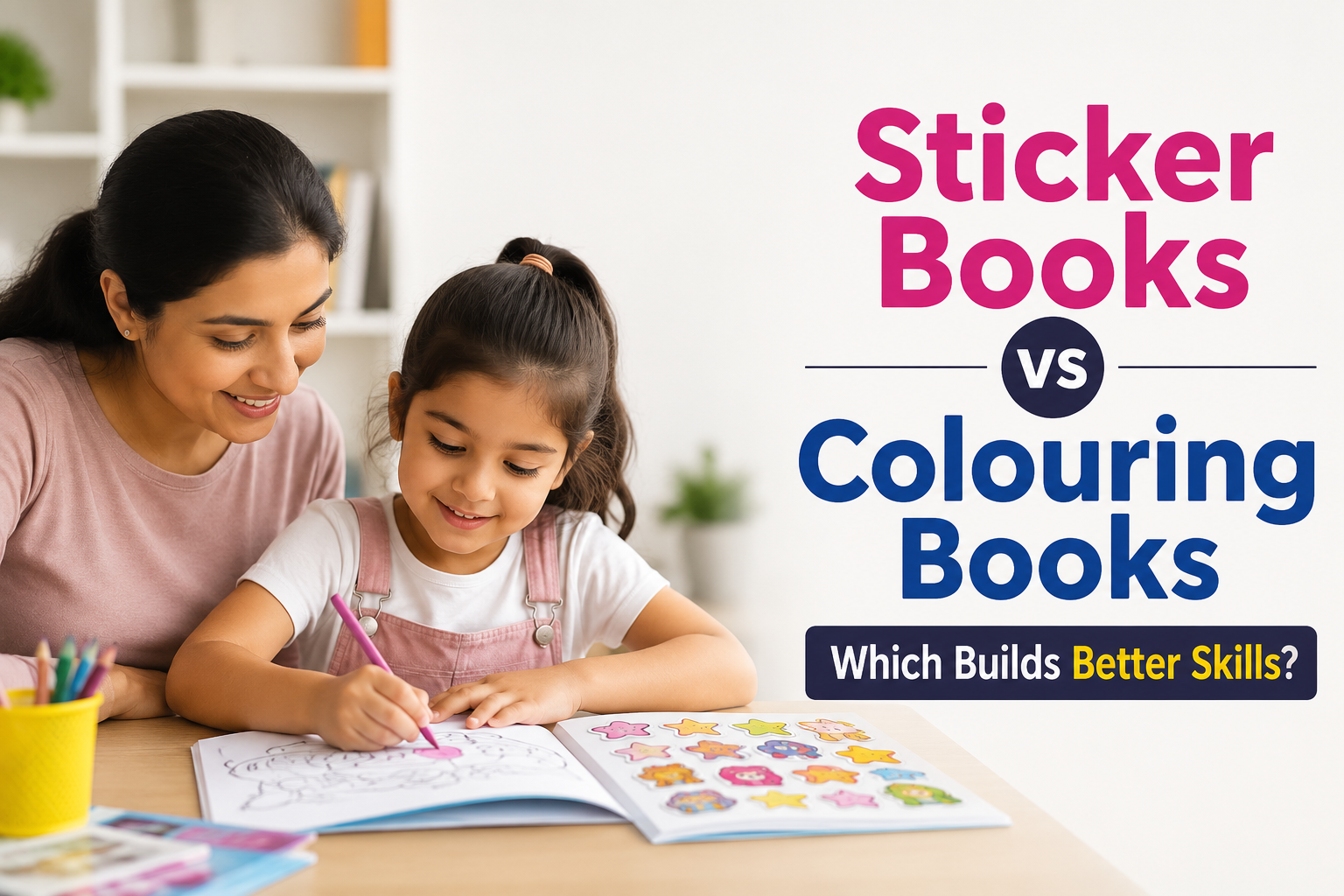
Our parents are blessed with a lot of options to educate their children and keep them busy while helping in their general development. Some of the most sought-after are children’s sticker books and colouring books for children. Both activities seem easy, but children gain valuable learning in their cognitive, creative and motor skills. For children, picking the right one among them is sometimes a choice depending on the age, interests and learning objectives of the child.
For some kids, adding stickers to finish the pictures is an exciting activity; for others, it’s all about filling pictures with colourful paint. The benefits of each activity differ and contribute to early childhood learning. It’s important to recognise that they’re not necessarily rivals; each helps to meet different developmental goals.
This guide contrasts sticker books and colouring books to assist parents in making informed decisions in selecting the appropriate books and to develop a well-rounded learning time.
Why Activity Books Matter During Early Childhood?
Early years children learn best from play and practical activities. Activity books promote exploration and build important school readiness skills. They help students to focus, think independently, and limit the time they spend on screens.
Children practise co-ordination, observation, patience and creativity in peeling stickers and/or colouring within outlines. Such fun things also promote confidence, as kids are able to successfully accomplish things without having to receive constant support from adults.
Sticker books
A sticker book for kids helps children to match, identify and stick a sticker in a particular place. A simple process that builds many skills at once.
Each sticker needs to be placed on the correct shape, colour and position in order for the child to observe the shape, colour and position first. Peeling activity helps build up muscle strength in the fingers, which can then be used for handwriting.
Most of the sticker activities are also an introduction to new concepts such as animals, fruits, vehicles, numbers, alphabets and daily activities. For instance, with an animal sticker booklets child identifies various animals, expands their vocabulary and develops observation skills.
Sticker-based activities encourage:
- Fine motor development
- Finger strength
- Visual discrimination
- Hand-eye coordination
- Problem-solving
- Vocabulary building
- Decision-making
- Independent learning
Children love to stick and paste colourful stickers, so they tend to spend more time on the activity.
Colouring Books
Sticker activities are more about creativity and imagination, whereas coloring books for kids are more about that too. Children select colour, try colour combinations and gradually develop their skills in holding a pencil.
Colouring helps to develop patience as it involves focus and consistency in completing a picture. It also aids kids to know their boundaries as they colour inside the boundaries.
The advantage of a copy colouring book is that it can be used to create a copy of the original. Children look at a coloured reference picture and try to make the same. This enhances their ability to recognise colour, look closely, remember, and accurately compare two pictures.
Colouring activities support:
- Pencil grip
- Creativity
- Colour recognition
- Concentration
- Patience
- Artistic confidence
- Spatial awareness
- Visual memory
These skills are more and more important as children go to school.
Here is a brief comparison of Sticker Books to Colouring Books:
| Skill Area | Sticker Books | Colouring Books |
| Fine motor skills | Excellent through peeling and placing stickers | Excellent through pencil control |
| Creativity | Moderate with scene completion | Very high through colour choices |
| Hand-eye coordination | Strong | Strong |
| Observation | Excellent | Very good |
| Concentration | High | High |
| Finger strength | Excellent | Good |
| Colour recognition | Moderate | Excellent |
| Problem-solving | High | Moderate |
As seen in the table, both activities foster slightly different skills and valuable ones at that.
Which Activity is better for Fine Motor Skills?
Fine motor skills are the use of the small muscles of children’s fingers and hands. These muscles play an important role in writing, buttoning clothes, tying shoelaces, and using scissors.
Sticker activities involve the child in a delicate peeling of very small stickers and the correct placement. These repetitions help to reinforce the proper use of the fingers without the use of a bar.
Colouring, on the other hand, enhances stability in the wrist and hand, as well as grip and controlled movement. Children slowly and progressively develop the ability to hold a crayon and a pencil properly and perform smooth strokes.
Sticker books can help younger preschool children improve their finger strength more quickly; colouring can help build up pencil skills as the children grow older.
Which One Leaves room for creativity?
Typically, colouring is more flexible when creativity is the aim.
The children can choose the colour of the sky: blue, purple or rainbow. They explore shades and patterns and play with emotions using colours.
Typically, sticker books offer ready-made pictures and blank spaces where children can stick their images, but there are some sticker activities that will leave children to be free to make their own pictures and stories.
Thus, colouring activities are used to increase imaginative thinking and sticker activities are used to increase logical thinking and visual organisation.
Age-Wise Recommendations
Developmental readiness is also a key factor in selection of the appropriate activity.
Larger stickers may appeal to kids between the ages of 2 and 4, as they are easier to grip. Sticker books are a fun way to learn simple words and learn to coordinate the placement of stickers without needing complex pencils skills.
Between four and six years of age, children are helped by doing stickers and colouring. At this time, they become more confident with holding crayons and continue to tackle matching and placing games.
For older kids there are more complex colouring pages, learning activity books themed with the images and sticker puzzles that develop creativity and educational preparedness.
Why is it that it’s best if you combine both?
Parents may not have to select just one choice.
Having sticker books and colouring books together is a good balance of learning. The activities with stickers help reinforce precision, observation, and logical thinking, and colouring assignments help foster creativity, patience, and artistic self-assurance.
A child can do a sticker activity in the morning to help develop their focus and then spend some quiet time colouring in to express themselves.
Alternating activities help to avoid boredom and provides fresh and exciting learning.
Tips for Parents
There are a few simple strategies that can ensure maximised learning outcomes:
- Choose activity books for the appropriate age level.
- Do not correct all the children’s errors but encourage them.
- Encourage to try rather than to be perfect.
- Let children make their own colour selections.
- Talk about images, objects and animals during activity completion.
- Plan regular, not occasional creative play.
- Keep completed pages to boost children’s confidence.
Learning is achieved better from small, regular learning activities rather than long, tiring activities.
Conclusion
There is no right or wrong answer as to which book to choose, as both sticker and colouring books play a part in children’s development. Sticker books for children are great for improving the fine motor skills, coordination and observation skills whilst colouring books for children enhance creativity, patience and artistic expression. An animal sticker book is used for interactive play, introducing new vocabulary and concepts, while a copy colouring book is used for guided practice to reinforce colour recognition and visual memory in children.
Parents need not pick between the two but can integrate both types into one activity for a more enriched learning experience that will meet all needs of early childhood development.
FAQs
- Is it appropriate to use sticker books with pre-schoolers?
Yes. Pre-schoolers use sticker books to develop finger strength, coordination, vocabulary and observation skills and to have fun learning.
- Do children develop better handwriting when they colour?
Yes. Colouring exercises help to strengthen pencil grip, wrist control and hand muscles to aid handwriting development in the future.
- What is the benefit of using a copy colouring book?
Colouring a copy colouring book allows children to carefully watch and observe colours, enhance visual memory, increase accuracy, and focus better by recreating the colours and images.
- Why is it a good idea for parents to select an animal sticker book?
An animal sticker book helps children learn about a variety of animals as well as improves vocabulary, recognition and fine motor skills through interactive play.
- Do you think it is better to select sticker books or colouring books?
Best to use both! Sticker books provide children with coordination and precision skills, while colouring books allow children to be creative and build their artistic confidence.

Comments are closed.