


Parents can make cursive writing practice more fun by keeping sessions short, using a cursive writing practice book that has a clear path, and turning letters into small games. A simple daily routine and a little praise go a long way.
Does your child groan when you say “time to write”? You’re not alone. Cursive is telling a child to connect letters in one flowing line, and that feels hard at first. Here are 7 simple ways to make practice easier and more fun.
Why Kids Aren’t Interested In Cursive Anymore?
Kids get bored when practice is long, repetitive, and has no clear goal. One of these reasons causes most children to give up:
- It’s tough to join letters. Print letters are separate. Cursive letters connect, so the child has to think ahead to the next letter while writing the current letter.
- Long sessions tire little hands. Lines get messy and young fingers get sore.
- The practice seems like a chore. Pages of the same letter are boring, not like a game.
- No visible progress. If the child does not improve, the effort is pointless.
Knowing the cause makes it easier to select the fix.
What Is The Right Age To Learn Cursive Writing?
In many schools, cursive is introduced between Class 1 and Class 3, which is around 6 to 8 years old. This varies by school and by child, so look for signs of readiness rather than counting birthdays.
If your child:
- Holds the pencil with your thumb, index and middle finger
- Writes letters in print with good control.
- Holds the line and keeps letters a similar size
Don’t rush. Print comes first, and cursive follows. A child who still has difficulty with print letters needs more print practice, not a push into cursive.
7 Fun Ways to Practice Cursive Writing
1. Begin with Warm-Up Strokes
Each cursive letter is made up of several basic strokes: loops, waves, curves and slanted lines. A child who can draw these smoothly will find letters so much easier.
Start your session with one minute of strokes. Ask your child to draw a row of waves, then a row of loops. It’s called warming up the pencil. It’s quick, and it conditions the hand for the letters that are to follow.
2. A Cursive Writing Practice Book With a Clear Pathway
A good cursive writing book moves in very small steps. Child confused by random pages and no order. A clear path breeds confidence.
Look for a workbook that goes in this order:
- Progression by letter, often starting with letters with similar strokes
- Dotted tracing, then free writing
- Lines that show where each letter sits
- Joining practice for 2 and 3 letters
- Words, then short sentences
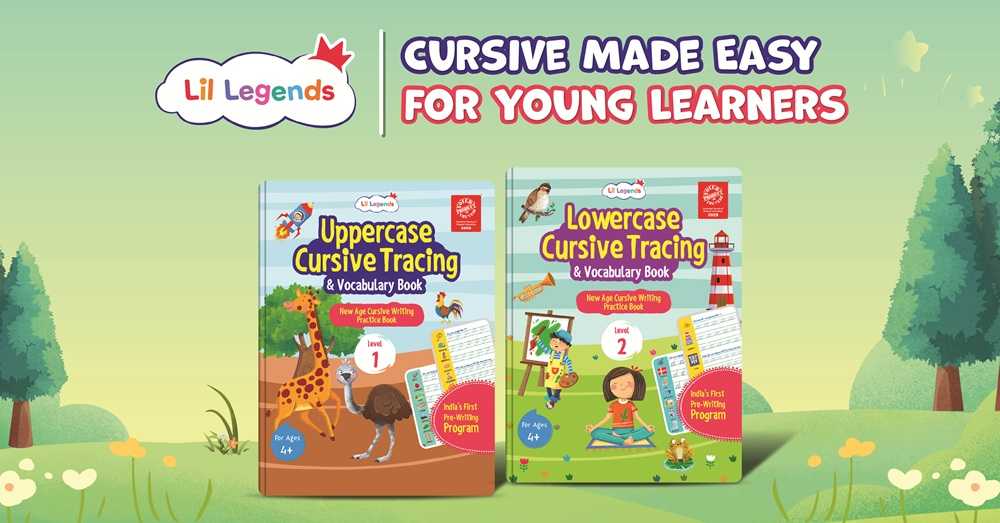
See if Lil Legends cursive writing books go down this road before you purchase. Select a book with a page count that is suitable for your child’s reading ability, not just their age.
3. Limit Sessions to 10-15 Minutes
Short and daily writing practice is better than long and rare. The child’s attention and hand tire quickly. Most kids do okay with a target of 10 to 15 minutes.
Try this easy routine:
- Warm-up (2 min)
- One new letter traced, then written alone (5 minutes)
- One word that has the letter (3 min)
Stop when your child is still feeling well. Makes it easier to begin tomorrow’s session.
4. Make Writing Game
Games help to keep practice interesting. Try these:
- Sand or salt tray. Salt sprinkled on a plate. Let your child trace the letter with one finger. The wiggly lines teach the shape without the stress of using a pencil.
- Air writing. Write the letter in the air together and guess the other person’s letter.
- Letter treasure hunt. Choose a letter. Let your child find three things around the house that start with it, then write each word in cursive.
- Beat your best line. Get your child to write one line and then have a go yourself and beat it. The aim is a better line, not a perfect line.
5. Let Your Child Write What They Want
Kids work harder when the words mean something. Instead of copying random words, ask your child to write:
- Their own name
- A friend’s or your pet’s name
- Happy Birthday card to a relative
- A grocery list or a quick note on the fridge
Real writing teaches your child the usefulness of the skill.
6. Add Small Rewards & a Progress Tracker
Visible progress motivates a child. Draw a basic chart on the wall. Put a sticker or stamp on each completed page or each completed week.
Praise effort. Say “Your loops look smoother today” instead of “That is perfect.” Specific praise helps your child know what to do again.
7. Don’t Sit Over Your Child, Sit Beside Them
Sit down next to your child and write a line yourself. Children copy what they see. Practice feels more like a shared activity and less like an evaluation.
When you give feedback, fix one thing at a time. Choose the most important one, such as letter size or slant, and put the rest aside for another day.
How to Choose the Best Cursive Writing Book for Kids?
The best handwriting book is one your child can use by himself and enjoy. Compare this checklist with handwriting books for kids:
- Difficulty level matches your child’s current level
- Large lines, easy to follow
- Easy instructions, simple words
- Colourful pages not crowded
- Enough practice space for writing
Lil Legends offers books for different stages. Pick the book that matches your child’s level, and you can move up when they are ready.
Common Mistakes Parents Make When Teaching Cursive
Most of these errors are made with good intentions. Avoid them:
- Fixing every letter. Too many corrections will kill motivation. Change one thing at a time.
- Forget pencil grip & posture. A strong grip and a bent back soon tire the child. Double-check before you start.
- Starting the sentences too soon. Letters and joins should be easy first.
- Comparing with other children. Each child moves at their own speed.
FAQs About Cursive Writing
Should kids learn cursive before they learn print writing?
No. Most kids learn print first, cursive second. Print builds basic letter forms and pencil control.
How long does it take to learn cursive writing?
It is determined by the age of the child, the control of the hand and the amount of practice. With some short daily practice, most children make steady progress over a few months.
Does cursive writing make you write faster?
Could help. Cursive letters connect so the pencil lifts less. You still get faster with practice, so don’t expect to be fast at the beginning.
What is more useful: a book of cursive writing or a plain notebook?
A cursive writing book is better at the beginning. It has guide lines, tracing, and step order. Later, when your child is confidently writing joined letters, a plain notebook will do.
Conclusion
Parents can help children build confidence and improve their handwriting a little at a time through short daily sessions, a well-organised cursive writing practice book, easy games and heaps of encouragement. Begin with simple strokes, then letters and words, and let your child practise writing what they like. Remember, progress is better than perfection.
Choose the appropriate practice book for your child’s level; reward small successes; and include cursive writing in a positive aspect of their daily schedule.

Comments are closed.